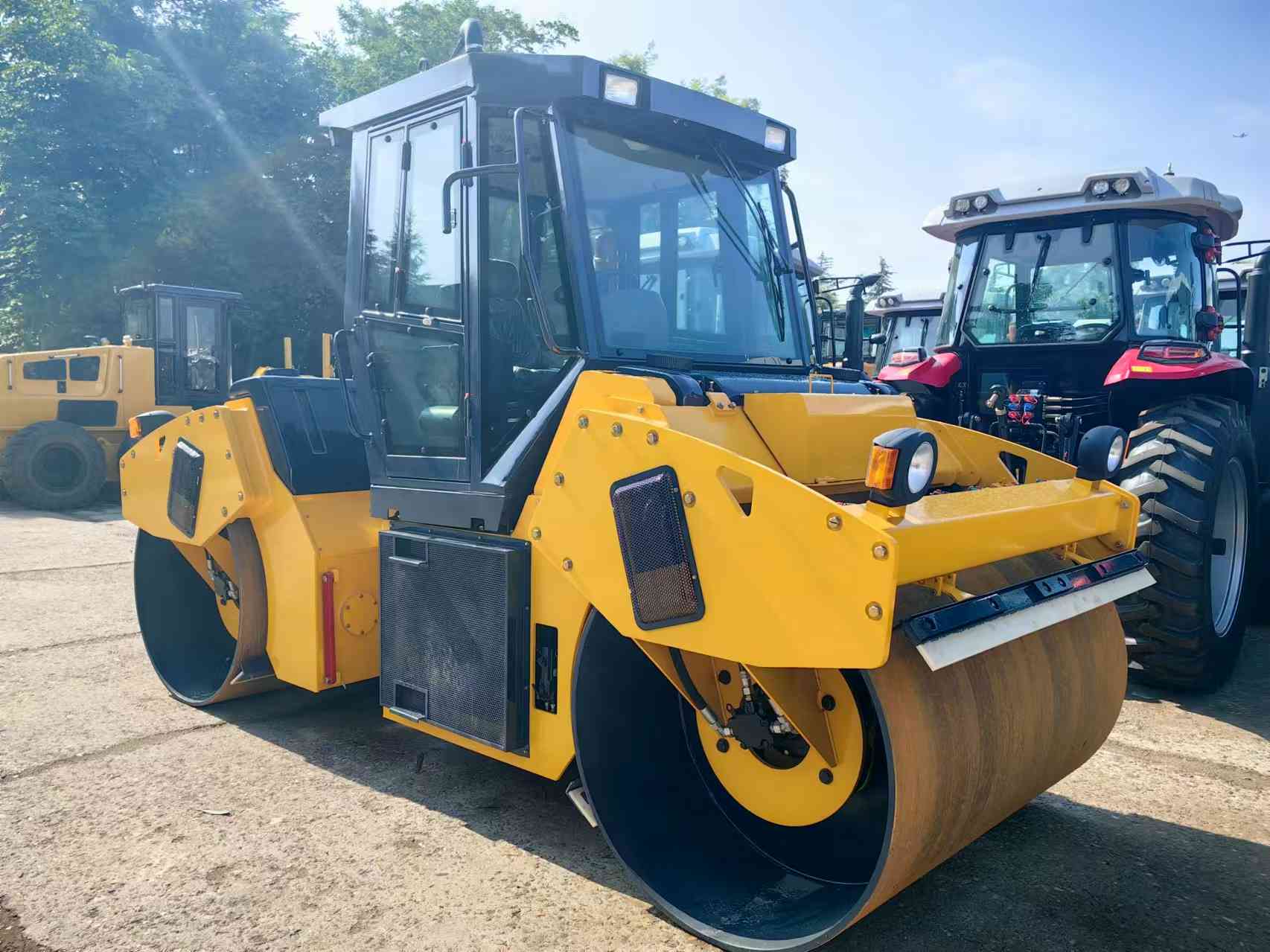
As a key machinery in road construction, the double drum road roller belongs to the category of engineering compaction equipment, widely used in filling and compaction operations for large projects such as high-grade highways, railway subgrades, airport runways, and water conservancy dams. Relying on the gravitational static pressure of steel drums, this road roller can effectively compact sandy soil, cohesive soil, subgrade stabilized soil, and asphalt concrete pavement layers. The mechanical self-weight induces plastic deformation in the compacted layer, achieving dense and stable construction results.
The technological development of road rollers traces back to early natural or animal-powered compaction methods. In the mid-19th century, as Western road projects shifted to crushed stone paving, the need for compaction drove the invention of specialized equipment. The 1858 piezoelectric stone tool accelerated crushed stone road construction, followed by horse-drawn roller tools—protoypes of modern road rollers. The 1860 French steam road roller marked the first power-driven compaction equipment, significantly improving crushed stone road quality and efficiency, and ushering in the era of mechanized compaction.
In the early 20th century, internal combustion engine technology revolutionized road rollers. The first internal combustion-driven drum road roller emerged, shifting compaction equipment from steam to motorized power. During this period, tire compactors, dual-foot rollers, and smooth-wheel rollers appeared sequentially. The industry focused on optimizing static pressure principles—increasing roller weight to enhance linear pressure and compaction effect. This drive led to the development of ultra-large tire road rollers exceeding 200 tons, though innovations primarily centered on power systems and appearance at the time.
The true leap in road roller technology came in the 1970s with the integration of hydrostatic transmission, hydraulic control, and computer technologies. The introduction of hydraulic transmission enabled easy adjustment of drum vibration frequency via flow control, coupled with stepless continuous adjustment of vibration parameters (frequency, amplitude), drastically improving compaction efficiency and uniformity. For double drum road rollers, hydraulic-driven high-frequency vibration drums excel in asphalt pavement compaction—preventing aggregate breakage while ensuring layer density standards.
As core equipment in modern infrastructure, road rollers evolve around "efficiency, precision, and adaptability." Double drum road rollers, with their rigid steel drum compaction, play an irreplaceable role in constructing rigid bases (e.g., cement-stabilized soil) and flexible pavements (e.g., asphalt concrete). From early gravity-based rollers to today’s automated devices with hydraulic vibration and intelligent monitoring, each road roller innovation elevates road construction quality.
In the ongoing infrastructure boom, double drum road rollers and other compaction equipment grow increasingly vital—safeguarding project quality and driving construction efficiency. With the deepening of green construction and intelligent technologies, road rollers are advancing toward low-energy consumption, high-precision, and multi-functional solutions, laying a solid foundation for global transportation networks and civil engineering projects.